OGEA-101 Pdf Dumps & OGEA-101 Test Book
Wiki Article
P.S. Free & New OGEA-101 dumps are available on Google Drive shared by ExamDiscuss: https://drive.google.com/open?id=1eZJIudnYOUy0zN6LO-2J6hN6EN9s8gN4
Sometimes choice is greater than important. Good choice may do more with less. If you still worry about your exam, our OGEA-101 braindump materials will be your right choice. Our exam braindumps materials have high pass rate. Most candidates purchase our products and will pass exam certainly. If you want to fail exam and feel depressed, our OGEA-101 braindump materials can help you pass exam one-shot. ExamDiscuss sells high passing-rate preparation products before the real test for candidates.
Our OGEA-101 exam question has been widely praised by all of our customers in many countries and our company has become the leader in this field. Our OGEA-101 exam questions boost varied functions and they include the self-learning and the self-assessment functions, the timing function and the function to stimulate the OGEA-101 Exam to make you learn efficiently and easily. There are many advantages of our OGEA-101 study tool. To understand the details of our OGEA-101 practice braindump, you can visit our website ExamDiscuss.
OGEA-101 Test Book | OGEA-101 Practice Online
Our products are the accumulation of professional knowledge worthy practicing and remembering. There are so many specialists who join together and contribute to the success of our OGEA-101 guide quiz just for your needs. Our responsible and patient staff who has being trained strictly before get down to business and interact with customers. Once you have practiced and experienced the quality of our OGEA-101 Exam Preparation, you will remember the serviceability and usefulness of them. It explains why our OGEA-101 practice materials helped over 98 percent of exam candidates get the certificate you dream of successfully. Believe me you can get it too.
The Open Group OGEA-101 Exam Syllabus Topics:
| Topic | Details |
|---|---|
| Topic 1 |
|
| Topic 2 |
|
| Topic 3 |
|
| Topic 4 |
|
| Topic 5 |
|
| Topic 6 |
|
The Open Group TOGAF Enterprise Architecture Part 1 Exam Sample Questions (Q45-Q50):
NEW QUESTION # 45
Which of the following describes how the Enterprise Continuum is used when developing an enterprise architecture?
- A. To describe how an architecture addresses stakeholder concerns
- B. To classify architecture and solution assets
- C. To identify and understand business requirements
- D. To coordinate with the other management frameworks in use
Answer: B
Explanation:
The Enterprise Continuum consists of two complementary concepts: the Architecture Continuum and the Solutions Continuum1. The Architecture Continuum provides a consistent way to describe and understand the generic and reusable architecture building blocks, such as models, patterns, and standards, that can be applied and tailored to specific situations2. The Solutions Continuum provides a consistent way to describe and understand the specific and implemented solution building blocks, such as products, services, and components, that realize the architecture building blocks3. The Enterprise Continuum enables the reuse and integration of architecture and solution assets across different levels of abstraction, scope, and detail, ranging from foundation architectures to organization-specific architectures1.
The Enterprise Continuum is used when developing an enterprise architecture to support the following activities1:
*Selecting relevant architecture and solution assets from the Architecture Repository or other sources, based on the business drivers, goals, and requirements
*Adapting and customizing the architecture and solution assets to suit the specific needs and context of the enterprise
*Defining and developing the target architecture and the architecture roadmap, based on the gaps and opportunities identified between the baseline and the target states
*Defining and developing the implementation and migration plan, based on the architecture roadmap and the solution building blocks
*Governing and managing the architecture and solution assets throughout the architecture lifecycle, ensuring their quality, consistency, and compliance References: 1: The TOGAF Standard, Version 9.2 - Enterprise Continuum 2: The TOGAF Standard, Version
9.2 - Architecture Continuum 3: The TOGAF Standard, Version 9.2 - Solutions Continuum
NEW QUESTION # 46
When considering the scope of an architecture, what dimension considers to what level of detail the architecting effort should go?
- A. Depth
- B. Breadth
- C. Project
- D. Architecture Domains
Answer: A
Explanation:
The scope of an architecture is the extent and level of detail of the architecture work. The scope of an architecture can be defined along four dimensions: project, breadth, depth, and architecture domains. The project dimension considers the boundaries and objectives of the architecture project, such as the time frame, budget, resources, and deliverables. The breadth dimension considers the coverage and completeness of the architecture across the enterprise, such as the organizational units, business functions, processes, and locations. The depth dimension considers the level of detail and specificity of the architecture, such as the granularity, abstraction, and precision of the architectural elements and relationships. The architecture domains dimension considers the aspects or segments of the architecture, such as the business, data, application, and technology domains.
Therefore, the depth dimension is the one that considers to what level of detail the architecting effort should go.
NEW QUESTION # 47
Consider the following ADM phases objectives.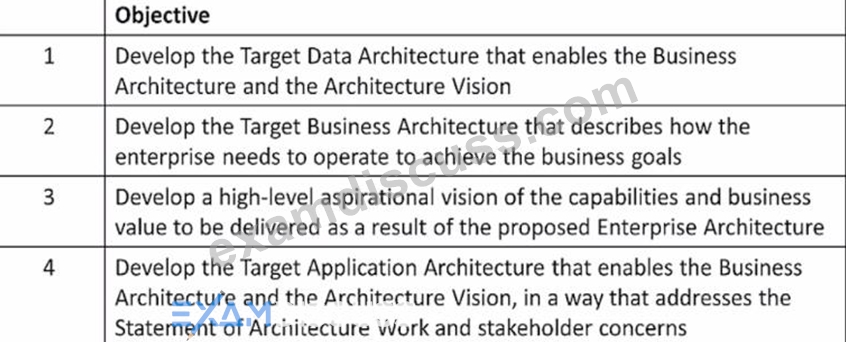
Which phase does each objective match?
- A. 1A-2B-3C-4D
- B. 1C-2D-3B-4A
- C. 1B-2D-3A-4C
- D. 1C-2B-3A-4C
Answer: D
Explanation:
* The objectives listed in the question correspond to the objectives of different phases of the TOGAF ADM (Architecture Development Method), which is a method for developing and managing an enterprise architecture1.
* The ADM consists of nine phases, each with a specific purpose and output. The phases are1:
oPreliminary Phase: To prepare and initiate the architecture development cycle, including defining the architecture framework, principles, and governance.
oPhase A: Architecture Vision: To define the scope, vision, and stakeholders of the architecture initiative, and to obtain approval to proceed.
oPhase B: Business Architecture: To describe the baseline and target business architecture, and to identify the gaps between them.
oPhase C: Information Systems Architectures: To describe the baseline and target data and application architectures, and to identify the gaps between them.
oPhase D: Technology Architecture: To describe the baseline and target technology architecture, and to identify the gaps between them.
oPhase E: Opportunities and Solutions: To identify and evaluate the opportunities and solutions for implementing the target architecture, and to define the work packages and transition architectures.
oPhase F: Migration Planning: To finalize the implementation and migration plan, and to ensure alignment with the enterprise portfolio and project management.
oPhase G: Implementation Governance: To provide architecture oversight and guidance for the implementation projects, and to manage any architecture change requests.
oPhase H: Architecture Change Management: To monitor the changes in the business and technology environment, and to assess the impact and performance of the architecture.
* Based on the above definitions, we can match each objective with the corresponding phase as follows:
oObjective 1: Develop the Target Data Architecture that enables the Business Architecture and the Architecture Vision. This objective is achieved in Phase C: Information Systems Architectures, where the data architecture is defined as a subset of the information systems architecture2.
oObjective 2: Develop the Target Business Architecture that describes how the enterprise needs to operate to achieve the business goals. This objective is achieved in Phase B: Business Architecture, where the business architecture is defined as a subset of the enterprise architecture3.
oObjective 3: Develop a high-level aspirational vision of the capabilities and business value to be delivered as a result of the proposed Enterprise Architecture. This objective is achieved in Phase A: Architecture Vision, where the architecture vision is defined as a high-level description of the target architecture and its benefits4.
oObjective 4: Develop the Target Application Architecture that enables the Business Architecture and the Architecture Vision, in a way that addresses the Statement of Architecture Work and stakeholder concerns. This objective is achieved in Phase C: Information Systems Architectures, where the application architecture is defined as a subset of the information systems architecture2.
Reference:
* 1: The TOGAF Standard, Version 9.2, Chapter 5: Architecture Development Method (ADM)
* 2: The TOGAF Standard, Version 9.2, Chapter 9: Phase C: Information Systems Architectures
* 3: The TOGAF Standard, Version 9.2, Chapter 8: Phase B: Business Architecture
* 4: The TOGAF Standard, Version 9.2, Chapter 7: Phase A: Architecture Vision
NEW QUESTION # 48
Which deliverable is first produced in Phase A, also updated in Phase E, and helps the architect to understand the baseline and target for the enterprise?
- A. Architecture Contracts
- B. Stakeholder Map
- C. Consolidated Gaps, Solutions, and Dependencies Matrix
- D. Capability Assessment
Answer: D
Explanation:
Comprehensive and Detailed Explanation
The question is about a deliverable that:
* Is first created in Phase A: Architecture Vision.
* Is updated in Phase E: Opportunities and Solutions.
* Helps the architect understand both the baseline and the target for the enterprise.
Let's review each option:
* A. Architecture Contracts
* These are created in Phase G: Implementation Governance.
* They formalize agreements between architecture and implementation teams, but are not produced in Phase A.
* Incorrect.
* B. Capability Assessment
* In Phase A, the Capability Assessment is produced to assess the organization's current capability maturity and to identify strengths and weaknesses (baseline).
* In Phase E, it is updated to reflect the required target capability and to inform planning of the work packages and Transition Architectures.
* This deliverable helps architects understand both baseline and target capability for the enterprise.
* Correct.
* C. Consolidated Gaps, Solutions, and Dependencies Matrix
* This is produced in Phase E to consolidate results from Gap Analysis across Phases B, C, and D.
* It is not started in Phase A, so it does not meet the condition.
* Incorrect.
* D. Stakeholder Map
* This is produced in Phase A as part of stakeholder management.
* It is not updated in Phase E, and it does not directly address baseline vs. target capability.
* Incorrect.
Correct Mapping
The deliverable that fits all three conditions is the Capability Assessment (B).
References
* The Open Group, TOGAF Standard, Version 9.2, Part II: ADM - Phase A (Capability Assessment as an input to the Architecture Vision) and Phase E (updated Capability Assessment to guide Opportunities and Solutions).
* The Open Group, TOGAF 9 Certified Study Guide - description of Capability Assessment as a baseline/target capability comparison tool.
NEW QUESTION # 49
Consider the following ADM phases objectives.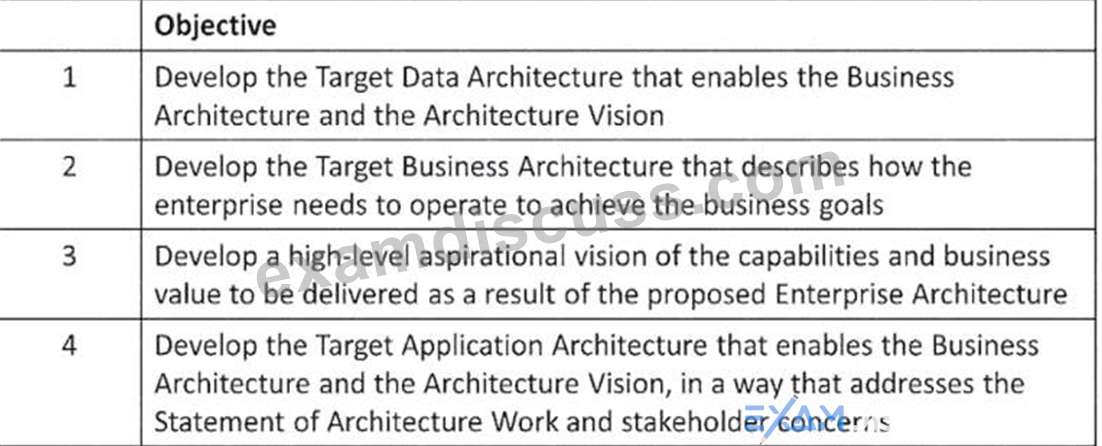
Which phase does each objective match?
- A. 1A-2B-3C-4D
- B. 1C-2D-3B-4A
- C. 1B-2D-3A-4C
- D. 1C-2B-3A-4C
Answer: D
Explanation:
The objectives listed in the question correspond to the objectives of different phases of the TOGAF ADM (Architecture Development Method), which is a method for developing and managing an enterprise architecture1.
The ADM consists of nine phases, each with a specific purpose and output. The phases are1:
Preliminary Phase: To prepare and initiate the architecture development cycle, including defining the architecture framework, principles, and governance.
Phase A: Architecture Vision: To define the scope, vision, and stakeholders of the architecture initiative, and to obtain approval to proceed.
Phase B: Business Architecture: To describe the baseline and target business architecture, and to identify the gaps between them.
Phase C: Information Systems Architectures: To describe the baseline and target data and application architectures, and to identify the gaps between them.
Phase D: Technology Architecture: To describe the baseline and target technology architecture, and to identify the gaps between them.
Phase E: Opportunities and Solutions: To identify and evaluate the opportunities and solutions for implementing the target architecture, and to define the work packages and transition architectures.
Phase F: Migration Planning: To finalize the implementation and migration plan, and to ensure alignment with the enterprise portfolio and project management.
Phase G: Implementation Governance: To provide architecture oversight and guidance for the implementation projects, and to manage any architecture change requests.
Phase H: Architecture Change Management: To monitor the changes in the business and technology environment, and to assess the impact and performance of the architecture.
Based on the above definitions, we can match each objective with the corresponding phase as follows:
Objective 1: Develop the Target Data Architecture that enables the Business Architecture and the Architecture Vision. This objective is achieved in Phase C: Information Systems Architectures, where the data architecture is defined as a subset of the information systems architecture2.
Objective 2: Develop the Target Business Architecture that describes how the enterprise needs to operate to achieve the business goals. This objective is achieved in Phase B: Business Architecture, where the business architecture is defined as a subset of the enterprise architecture3.
Objective 3: Develop a high-level aspirational vision of the capabilities and business value to be delivered as a result of the proposed Enterprise Architecture. This objective is achieved in Phase A: Architecture Vision, where the architecture vision is defined as a high-level description of the target architecture and its benefits4.
Objective 4: Develop the Target Application Architecture that enables the Business Architecture and the Architecture Vision, in a way that addresses the Statement of Architecture Work and stakeholder concerns. This objective is achieved in Phase C: Information Systems Architectures, where the application architecture is defined as a subset of the information systems architecture2.
1: The TOGAF Standard, Version 9.2, Chapter 5: Architecture Development Method (ADM)
2: The TOGAF Standard, Version 9.2, Chapter 9: Phase C: Information Systems Architectures
3: The TOGAF Standard, Version 9.2, Chapter 8: Phase B: Business Architecture
4: The TOGAF Standard, Version 9.2, Chapter 7: Phase A: Architecture Vision
NEW QUESTION # 50
......
We offer three different formats for preparing for the The Open Group OGEA-101 exam questions, all of which will ensure your definite success on your TOGAF Enterprise Architecture Part 1 Exam (OGEA-101) exam dumps. ExamDiscuss is there with updated OGEA-101 Questions so you can pass the TOGAF Enterprise Architecture Part 1 Exam (OGEA-101) exam and move toward the new era of technology with full ease and confidence.
OGEA-101 Test Book: https://www.examdiscuss.com/TheOpenGroup/exam/OGEA-101/
- OGEA-101 Testking Learning Materials ???? New OGEA-101 Exam Objectives ???? Standard OGEA-101 Answers ???? Open 《 www.pdfdumps.com 》 enter ➠ OGEA-101 ???? and obtain a free download ????OGEA-101 Sample Test Online
- OGEA-101 Reliable Test Topics ???? New OGEA-101 Real Test ???? OGEA-101 Flexible Testing Engine ???? Search for ➽ OGEA-101 ???? and download it for free immediately on ➽ www.pdfvce.com ???? ????OGEA-101 Valid Exam Question
- OGEA-101 Sample Test Online ???? Standard OGEA-101 Answers ???? OGEA-101 Exam Questions Vce ???? Open ▛ www.prepawayete.com ▟ and search for ▷ OGEA-101 ◁ to download exam materials for free ????Formal OGEA-101 Test
- Types of Real The Open Group OGEA-101 Exam Questions ???? Open ➡ www.pdfvce.com ️⬅️ and search for ☀ OGEA-101 ️☀️ to download exam materials for free ????Study OGEA-101 Materials
- TOGAF Enterprise Architecture Part 1 Exam Exam Guide Have Reasonable Prices but Various Benefits Study Questions ???? ⏩ www.dumpsquestion.com ⏪ is best website to obtain [ OGEA-101 ] for free download ????OGEA-101 Flexible Testing Engine
- OGEA-101 Exam Pdf Dumps- Latest OGEA-101 Test Book Pass Success ???? 「 www.pdfvce.com 」 is best website to obtain ➤ OGEA-101 ⮘ for free download ????OGEA-101 Testking Learning Materials
- Top OGEA-101 Pdf Dumps 100% Pass | High-quality OGEA-101 Test Book: TOGAF Enterprise Architecture Part 1 Exam ???? Open “ www.vce4dumps.com ” and search for ➡ OGEA-101 ️⬅️ to download exam materials for free ⏪New OGEA-101 Exam Objectives
- OGEA-101 Exam Guide and OGEA-101 Exam Prep - OGEA-101 Exam Torrent ???? Search on ▷ www.pdfvce.com ◁ for “ OGEA-101 ” to obtain exam materials for free download ????Standard OGEA-101 Answers
- Reliable The Open Group OGEA-101 PDF Questions - Pass Exam With Confidence ???? Download 「 OGEA-101 」 for free by simply entering 《 www.pdfdumps.com 》 website ????Standard OGEA-101 Answers
- Types of Real The Open Group OGEA-101 Exam Questions ???? ➠ www.pdfvce.com ???? is best website to obtain ➡ OGEA-101 ️⬅️ for free download ????Standard OGEA-101 Answers
- 2026 OGEA-101 Pdf Dumps | High Pass-Rate OGEA-101 Test Book: TOGAF Enterprise Architecture Part 1 Exam ???? Enter ( www.vce4dumps.com ) and search for ➥ OGEA-101 ???? to download for free ????OGEA-101 Testking Learning Materials
- bookmarkhard.com, estelleagab046217.wikimidpoint.com, bookmarklethq.com, aliciazplo990892.buscawiki.com, mypresspage.com, nelsonvfin938782.blogcudinti.com, myportal.utt.edu.tt, myportal.utt.edu.tt, myportal.utt.edu.tt, myportal.utt.edu.tt, myportal.utt.edu.tt, myportal.utt.edu.tt, myportal.utt.edu.tt, myportal.utt.edu.tt, myportal.utt.edu.tt, myportal.utt.edu.tt, zaynabwxug389366.webbuzzfeed.com, sites2000.com, www.stes.tyc.edu.tw, Disposable vapes
BTW, DOWNLOAD part of ExamDiscuss OGEA-101 dumps from Cloud Storage: https://drive.google.com/open?id=1eZJIudnYOUy0zN6LO-2J6hN6EN9s8gN4
Report this wiki page